
Brownstown City Directory Holdings
Brownstown did not publish a verified township-only directory series in the research reviewed here. The strongest route is a set of regional and statewide collections, searched with Brownstown, Wayne County, and neighboring place names. The Library of Michigan city-directory guide identifies the formats and access points, while the historical runs below show where a Brownstown lead may appear. A listing can identify a household or a business connection at a point in time. It does not by itself prove present residence, ownership, or a relationship between people with the same surname.
| Collection | Years | Where Held | Access |
|---|---|---|---|
| Polk directories | Late 1800s onward; exact Brownstown run not located | Library of Michigan and licensed library databases | Surname and street sections; patterns vary by volume |
| Bresser and criss-cross volumes | Especially useful from the late 1960s; exact Brownstown run not located | Library of Michigan and regional holdings | Street, house-number, household and owner/renter clues where printed |
| Dearborn and Downriver Bresser | 1953; 1955-72; 1974-86; 1988-90; 1992-95; 2007; 2008 | Dearborn Genealogical Society guide and partner holdings | Inspect the actual title for Brownstown coverage |
| Nearby Downriver and Trenton titles | Down-river 1945, 1947, 1954, 1956; Trenton 1933, 1956, 1959 | Regional catalog leads | Holding-level verification required |
| Detroit Burton directories | 1837; 1845-46; 1850-1941; selected East/West volumes through 1974 | Detroit Public Library Burton Historical Collection | Detroit and Wayne context; Brownstown coverage varies |
The table is a search plan, not proof that every title indexed Brownstown. Regional publishers could sort an address under Trenton, Riverview, Flat Rock, or another postal place. State gazetteers, available from roughly the mid-1860s through 1931/32, add township and business context when a household cannot be found in a city volume. Note: Record the publisher, year, page or image, and place label before comparing any two entries.
Brownstown Library Directory Volumes
Trenton Veterans Memorial Library serves Brownstown, Grosse Ile, Trenton, and Woodhaven, making it a practical nearby stop for local-history work. It is at 2790 Westfield Road in Trenton. Listed hours are Monday through Thursday, 9 a.m. to 8 p.m., and Friday and Saturday, 9 a.m. to 5 p.m.; it is closed Sunday. Verify holiday hours before a visit. Its online description did not identify exact Brownstown directory shelf years, so ask about the specific surname, road, publisher, and date range rather than assuming a volume is on hand.
The library's Michigan Electronic Library resources include MyHeritage Library Edition, census records from 1790 through 1940, and MeLCat. Ancestry Library Edition is generally available in the library. Those services can connect an address or household found in a printed volume to a census image, an obituary lead, or another catalog location. A library card can be established by eligible local residents using the identification and local-address documentation listed by the library.
See the Trenton library genealogy resources before planning a database session.
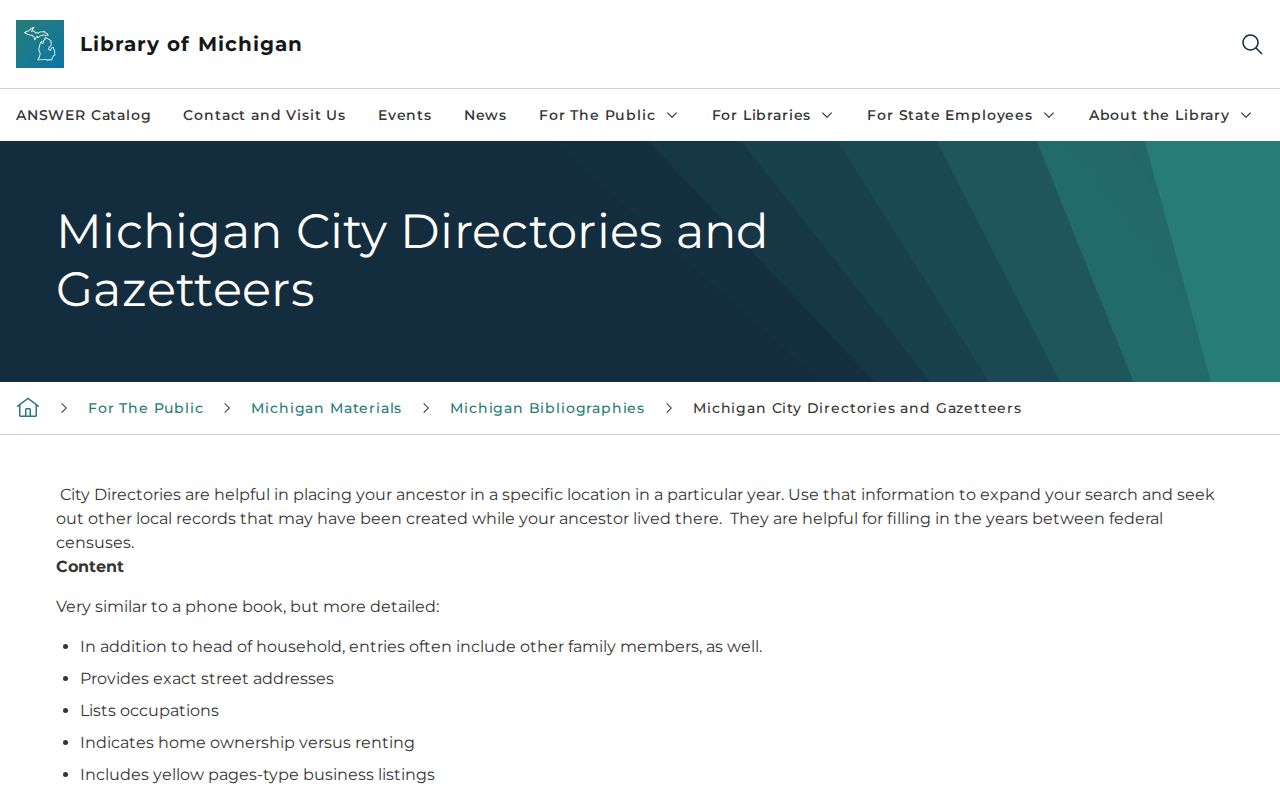
The Library of Michigan material distinguishes publisher formats, which matters when a surname search and a street search give different results.
Brownstown Polk and Bresser Directories
Publisher format changes the order of the search. The Library of Michigan describes Polk volumes as having an alphabetical surname section that can include occupation, other household members, and ownership information. A Polk street section is arranged by street and house number and may distinguish homeowner from renter. Phone and classified sections can add leads. Bresser, often called a criss-cross directory, works in the reverse direction: street first, then house number, followed by clues such as the head of household, phone, and owner or renter status where printed.
Do not fill gaps with expected fields. No actual Brownstown or Downriver page image was inspected for this research, and a field that appears in one publisher or year may be absent from another. For a Brownstown city directory result, save the title, publisher, year, page or image, printed name, address, occupation, phone, owner/renter indication, postal place, and collection name exactly as shown. That record makes later comparisons testable.
At the Library of Michigan, print directories are in 2nd Floor South by city or county, rare books are in call-number order, and microfilm or fiche is in the 2nd Floor South Microfilm Room. Search the ANSWER catalog for a city-name directory, then confirm the publisher and volume before making the trip. Those physical and catalog routes matter because exact Brownstown runs were not located online.
Brownstown Downriver Directory Runs
The Dearborn Genealogical Society directory guide lists Polk directories for Wayne, Garden City, and Inkster in 1947, 1951, 1954, 1956, 1958, and 1960. It also identifies the long Dearborn and Downriver Bresser sequence in the collections table. These are strong regional leads for a family who moved through Downriver communities, but the title page, geographic scope, and actual holdings still need inspection before a Brownstown address is claimed as covered.
Catalog leads add Down-river City Directory years 1945, 1947, 1954, and 1956, plus Trenton directories from 1933, 1956, and 1959. The same sources identify a Wyandotte and River Rouge series for 1907-1933 that includes Ecorse, Grosse Ile Township, Riverview, and Trenton. Search the historical township name beside the road, surname, or known trade. Nearby postal-city titles can preserve a Brownstown connection that a municipality-only search misses.
For older regional holdings, the Burton Historical Collection also lists Detroit directory runs, statewide telephone directories, marriage and death indexes, a Wayne County probate estate packet index, and early land transfers. Detroit titles should be treated as Wayne-area context, not as dependable Brownstown coverage.
Note: Catalog listings identify a lead, but only the held volume can establish its year, extent, and locality.
Reading a Brownstown City Directory Entry
Read a directory entry as a dated transcription, not a complete biography. Begin with the heading and abbreviation key, then capture every printed part of the entry. A name may be abbreviated. A spouse, occupation, phone number, owner/renter sign, or street address may be missing. The absence of a field only means that volume did not print it. The inventory below separates what a future local-page capture should record from what any particular entry is guaranteed to show.
| Directory title and year | Identifies the publisher, date, and volume being compared. |
|---|---|
| Printed name | Keep surname, given name, initials, spelling, and any household wording exactly as printed. |
| Address and postal place | Captures the street, number, city label, and any change in road spelling. |
| Occupation or business clue | May distinguish same-name people and guide newspaper or census research where printed. |
| Owner/renter, phone, or classification | Record only marks actually present, including the abbreviation key that explains them. |
| Page or image identifier | Lets another researcher return to the original page and check the transcription. |
- Criss-cross directory
- A reverse directory arranged by street and then house number, useful when the address is known before the household name.
- Householder index
- An alphabetical listing that generally emphasizes the head of a household rather than every person at the address.
- Abbreviation key
- The publisher's explanation of short marks and terms, often printed near the front of a volume and worth saving with the entry.
A city directory entry is strongest when its page identifier and abbreviation key travel with the transcription. A later researcher can then tell a printed fact from an inference drawn from another record.
Brownstown Boundary Changes in Directories
Brownstown's record trail crosses changing boundaries. It began as one of the original nine Wayne County townships, with sources disagreeing whether the designation date was April 5 or April 12, 1827. The first township meeting was held May 28, 1827. A historical directory search should retain that disagreement as a source note rather than choose one date. More important for a household search, a portion went to Monguagon in 1842, then Gibraltar formed in 1961, Rockwood incorporated in 1964, and Woodhaven and Flat Rock incorporated in 1965.
- 1827: Brownstown township was created or designated; the exact April date differs in official sources.
- 1842: A portion was added to Monguagon, so older family and property references may use that name.
- 1961: Gibraltar formed, changing the municipal label used in later records.
- 1964: Rockwood incorporated.
- 1965: Woodhaven and Flat Rock incorporated, leaving a fragmented charter township.
Search Brownstown, Monguagon, Gibraltar, Rockwood, Woodhaven, and Flat Rock as a historical cluster, but do not treat them as interchangeable present jurisdictions. Old directories may file a farm, business, or household under an adjacent postal city. The 1875 atlas also describes Flat Rock and Gibraltar as business centers, a useful way to expand a surname search with a historical place or trade term.
Brownstown Times Digitization Numbers
The Downriver Genealogical Society digitizing project reported more than 210,000 scanned newspaper pages by September 2025. Phase One is searchable at the Society Library and includes the Brownstown Times, Wyandotte News-Herald, and Township Tribune. That count is a useful measure of the regional material becoming available, not a promise that every Brownstown issue or name is online.
Pair a dated directory listing with a newspaper search for the surname, road, township, obituary, funeral, estate, election, appointment, or historic spelling. Preserve the publication title, issue date, and page. A notice can explain a move or a family connection, but a newspaper hit is still a lead that needs support from a vital, probate, deed, cemetery, or directory record.
Brownstown Historical Society Directory Leads
The Brownstown Historical Society offers an online database and museum as local-history leads. The museum opens on the second Saturday of each month from 1 to 4 p.m., and private tours may be requested. Its database is described as new, but its search fields, record counts, and update schedule were not verified in the research. Ask whether a result comes from an original record, a transcription, or a compiled history before using it to connect a person to an address.
Open the Historical Society database and museum resource when looking for township history, early census names, cemetery material, old maps, and roads that later fell within successor municipalities.
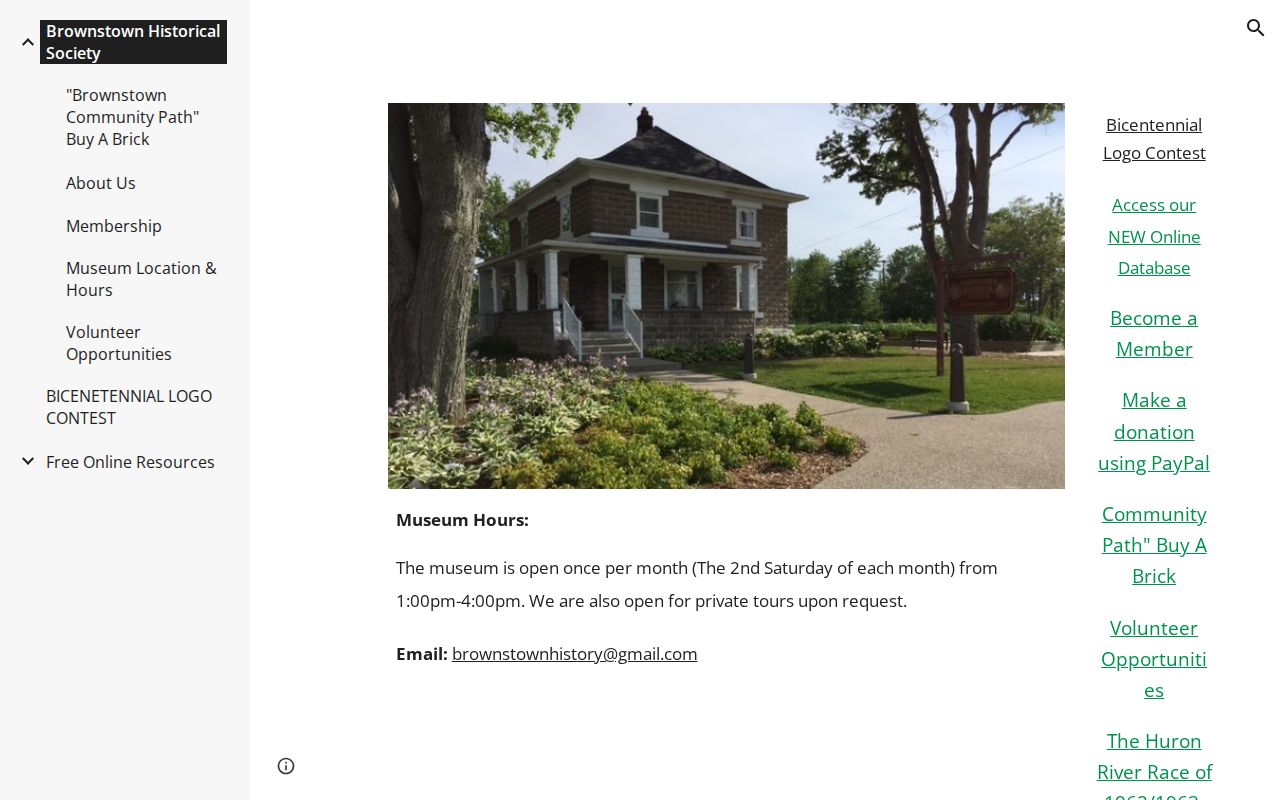
The Society is a local starting point for confirming whether an early name, road, cemetery, or municipal label belongs to the same historical Brownstown area.
The Society's cemetery account identifies Oak Ridge ownership in 1876 by Jacob Reese Vreeland and Abram Helferich and describes about 30 burials. Treat that compiled account as a historical lead. Cemetery and obituary details can help resolve a surname collision, yet a burial place does not establish a person's residence.
Note: Keep living relatives' addresses and contact details out of a family-history research file unless they are necessary for a lawful purpose.
Brownstown Directory Sources Beyond Print
FamilySearch's city and business directory collection covers approximately 1749-1990 and indexes names, occupations, and addresses. Login and free-access rules can vary. Search its record fields with the directory year, publisher, township, postal city, surname variant, and road where available. The collection was inspected through a 1951 Santa Barbara sample page, not a Brownstown page, so it demonstrates format rather than local coverage.
The 1893 Library of Congress Wayne County atlas is a digitized 152-page atlas, not a resident list. It can bridge a legal description to older roads, landowners, water features, and township/range/section references. Inspect Brownstown pages one at a time, then compare what they show against deed, census, and directory dates. The Archives of Michigan is a further route for county and local-government series that are rarely arranged by name.
Trace Brownstown City Directories by Household
Build a household trail one dated record at a time. Begin with the earliest dependable listing, then follow spelling, address, postal place, and occupation changes through later volumes. Pair directory years with the public census range from 1790 through 1950, and preserve uncertainty when the evidence only suggests the same household. A directory disappearance can mean a move, death, changed listing practice, or a volume with different coverage. It is not enough to make a conclusion on its own.
- Find the earliest likely entry by surname, initial, road, postal city, and historical Brownstown variant.
- Save the publisher, year, page or image, printed address, and every field that appears.
- Search the next available directory years for a move, spelling change, trade clue, or different municipal label.
- Match the directory interval to a census, obituary, newspaper notice, cemetery lead, deed, or probate record.
- Check Monguagon, Gibraltar, Rockwood, Woodhaven, and Flat Rock when boundaries or postal labels changed.
- Label the result exact source match, probable, possible, or unresolved instead of overstating the evidence.
A historical find that needs a modern, name-focused confirmation belongs in the Brownstown Township resident lookup, while address-first work belongs with the current parcel and street records. Historical volumes are strongest when they are treated as dated snapshots and linked to independently sourced records.