
What Brownstown Township Records Confirm
No official system supplies a complete roster of Brownstown Township residents. Each record answers a smaller question. Wayne County parcel and title records can tie a published owner or grantee to a parcel, but not prove present occupancy. A court portal can expose a public index entry, but not settle a same-name match. The best result keeps its date, custodian, and jurisdiction beside the name.
| Record | What it can confirm | Where | Access |
|---|---|---|---|
| Parcel and title | Published owner, grantee, parcel, or legal-description connection | Brownstown BS&A and Wayne Register of Deeds | Portal index, account, or custodian copy route |
| Court index | Public case number, party, event, and category when displayed | 33rd District, Wayne Circuit, or Wayne Probate | Free index with court-specific limits |
| Vital event | Documented birth, death, marriage, or divorce event | MDHHS Vital Records or Wayne County Clerk | Eligibility, written request, and fee rules |
| Voter record | A person's own registration information or defined public-file fields | Michigan Bureau of Elections and local clerks | Personal MVIC check or controlled QVF request |
| License record | Professional credential, status, and discipline when published | Michigan LARA MiPLUS | Free search; certified verification costs extra |
Choose the source by the question. A property connection belongs with parcel and deed records. A public case belongs with the court that had jurisdiction. A credential can help distinguish names, but does not establish that a licensee lives or works at a Brownstown Township address.
Build a Brownstown Township Lookup File
Begin with one full name and one non-sensitive discriminator: an approximate year, historical date, municipality, street, parcel, directory year, or court jurisdiction. A postal city alone is weak in Brownstown Township because mailing labels and municipal boundaries do not always match. Keep the exact spelling used, date inspected, search mode, result count, fields shown, and any notice that the result is unofficial or incomplete.
Mark each identity as exact, probable, possible, or unresolved. A current parcel owner, an old obituary entry, or a similar court party cannot become an unsupported claim about a Brownstown Township resident. For an address question, use the tax portal, parcel card, GIS map, and deed index as a separate trail. The full address method is available on the Brownstown Township Street Directory.
MiCOURT D33 Name Checks
The MiCOURT D33 case search is the district-court starting point when Brownstown Township area jurisdiction fits. Select the court, then use the name path with a last name or business name. First name, middle name, and birth year are optional narrowers. The alternative case-number path uses year, number, and type. Show filters narrow results, while Clear resets the form.
33rd District Court serves Brownstown, Flat Rock, Gibraltar, Grosse Ile, Rockwood, Trenton, and Woodhaven. Its posted address is 19000 Van Horn, Woodhaven, MI 48183, telephone 734-671-0201, with hours shown at about 8:15 a.m. to 4:15 p.m. It hears district civil, criminal, traffic, and related proceedings. Ticket instructions direct users to wait two business days before checking a name through MiCOURT D33.
The display is an unofficial informational index with no warranty or bulk download. Protected categories can be omitted, including juvenile and child-protective matters, adoptions, mental-illness proceedings, name changes, PPOs, and wills. A name hit should lead to direct court verification, not a label attached to a Brownstown Township resident.
See the MiCOURT D33 search screen before entering a name; it shows the court selector and separate name and case-number paths.
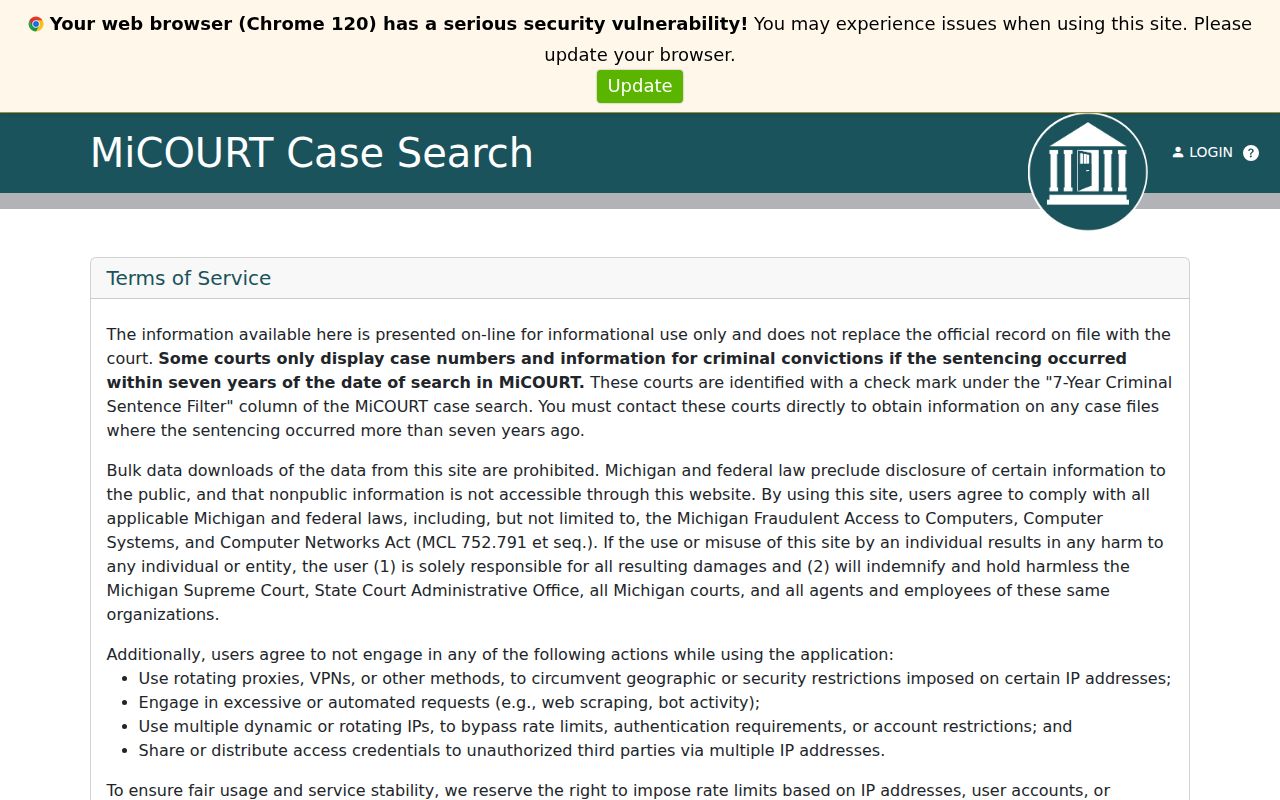
Those inputs make a birth year a narrowing detail, not proof of identity, and make a known case number the stronger search key.
Brownstown Township Court Paths for Name Checks
The Third Circuit case search offers public Odyssey categories for criminal records, non-criminal records, and a court calendar. Search by case number, party or defendant, attorney, or filing date. The public view is generally an index, register of action, or civil judgment and may cap results at 200. Documents are not always online; public kiosks are in the lower level of Coleman A. Young Municipal Center, and paper public files are handled through the Wayne County Clerk records room.
Wayne Probate Court accepts case number, first and last name, or company name. It can display summary, parties, events, docket activity, financial, and status tabs, with up to 100 results. Most documents filed since April 1, 2022 are online at no cost. Older images can be offline, sealed records are unavailable online, staff range searches of up to 50 cases are listed at $10, standard copies at $2 per page, and the inspected certified or exemplified schedule lists $11 for a first page plus $1 for each later page under MCL 600.2546.
For a federal case, the Eastern District of Michigan records page directs users to PACER and the nationwide Party/Case Index. Most electronic records need a login, and pre-electronic files may be archived. This is a jurisdiction check after the county routes, not a substitute for a local person record.
The Eastern District access view illustrates the federal record and account boundary.
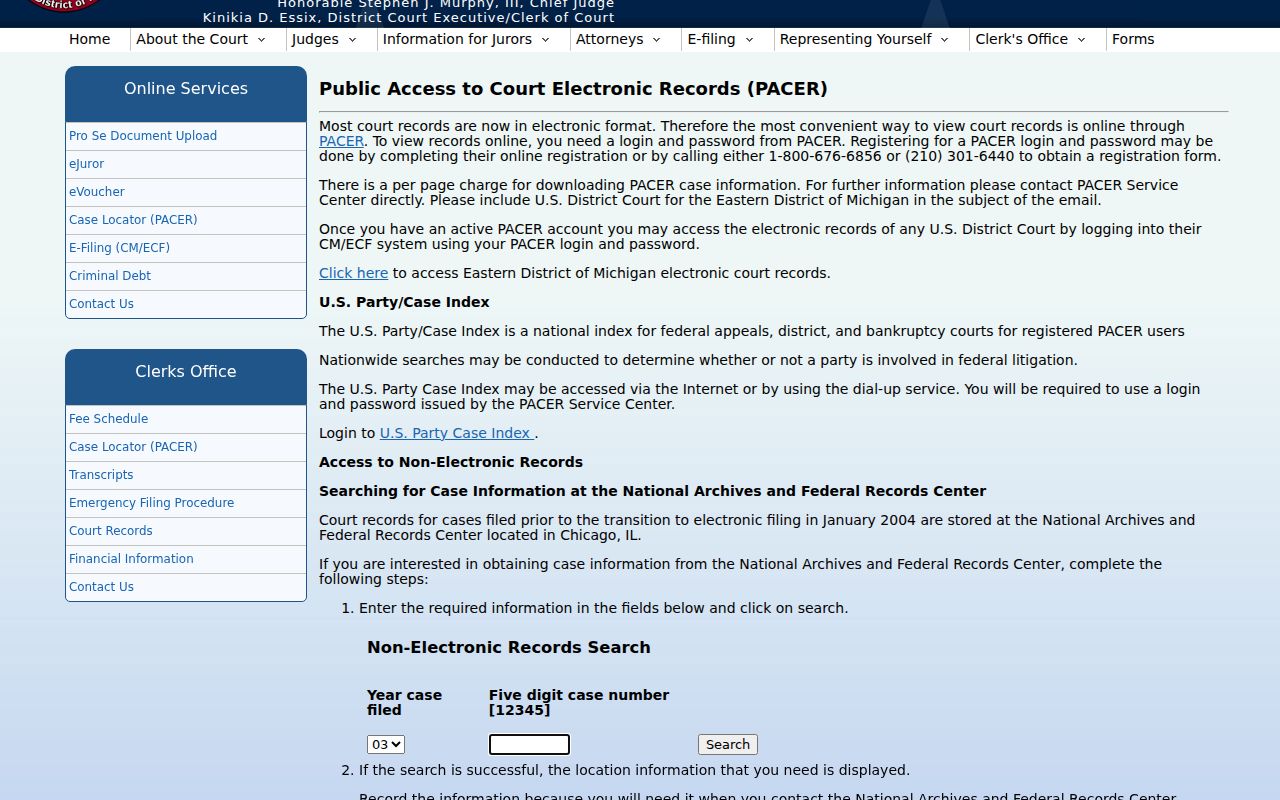
A party or case result identifies a possible court record, not current Brownstown Township residence or identity by itself.
Vital Records for Brownstown Township Lookup
Michigan Vital Records preserves statewide birth, death, marriage, and divorce records from 1867, but each type has its own access rules. The state offers mail, online or VitalChek ordering, phone, drop box, appointment, and Will Call where offered. Birth records under 100 years old are restricted to the subject, a named parent, legal guardian, qualifying heir or representative, court, documented power of attorney, or licensed attorney with required identification. Births 100 years or older use the broader genealogy route.
Deaths, marriages, and divorces have separate written-request and fee rules. MCL 333.2882 is the cited vital-record access anchor. Under the inspected eligibility information, death and marriage records may be requested with a written request and fee, while divorce requests also follow court-record rules. A vital event documents an event and place, not a person's later Brownstown Township address.
The Michigan Vital Records order page shows the state channels and eligibility details for a properly scoped request.
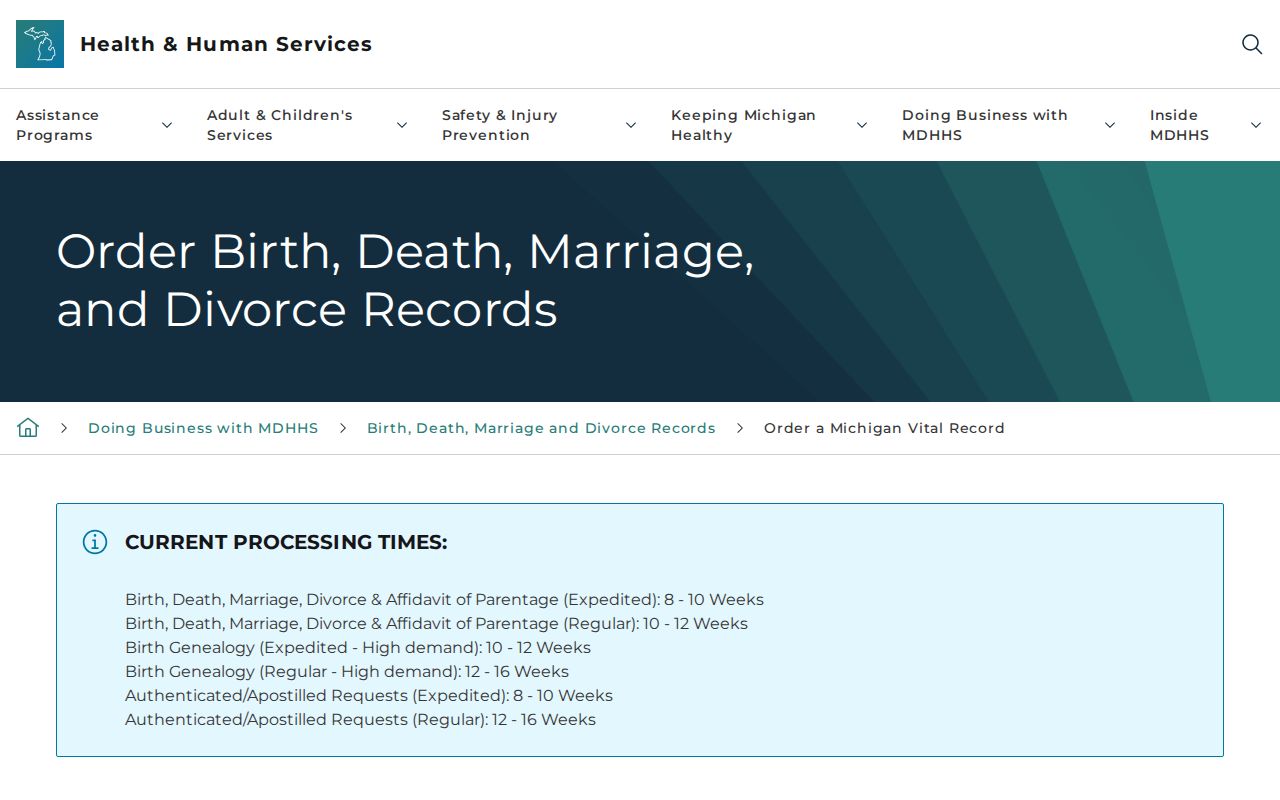
Use the order route that matches the record type and eligibility rather than treating an index as an unrestricted certificate.
The Wayne County Clerk Birth and Death Records Division is at 400 Monroe Street, Suite 610, Detroit, MI 48226, telephone 313-967-6938. Mail requests should include a signed request, return address, phone, subject's full birth name, date and city of birth, valid ID or two signature IDs, and payment. A home birth within one year may route through Wayne County only when the city or township does not register the birth, so confirm Brownstown Township's local registrar practice.
The Wayne County birth-record request page shows the county route and applicant requirements.
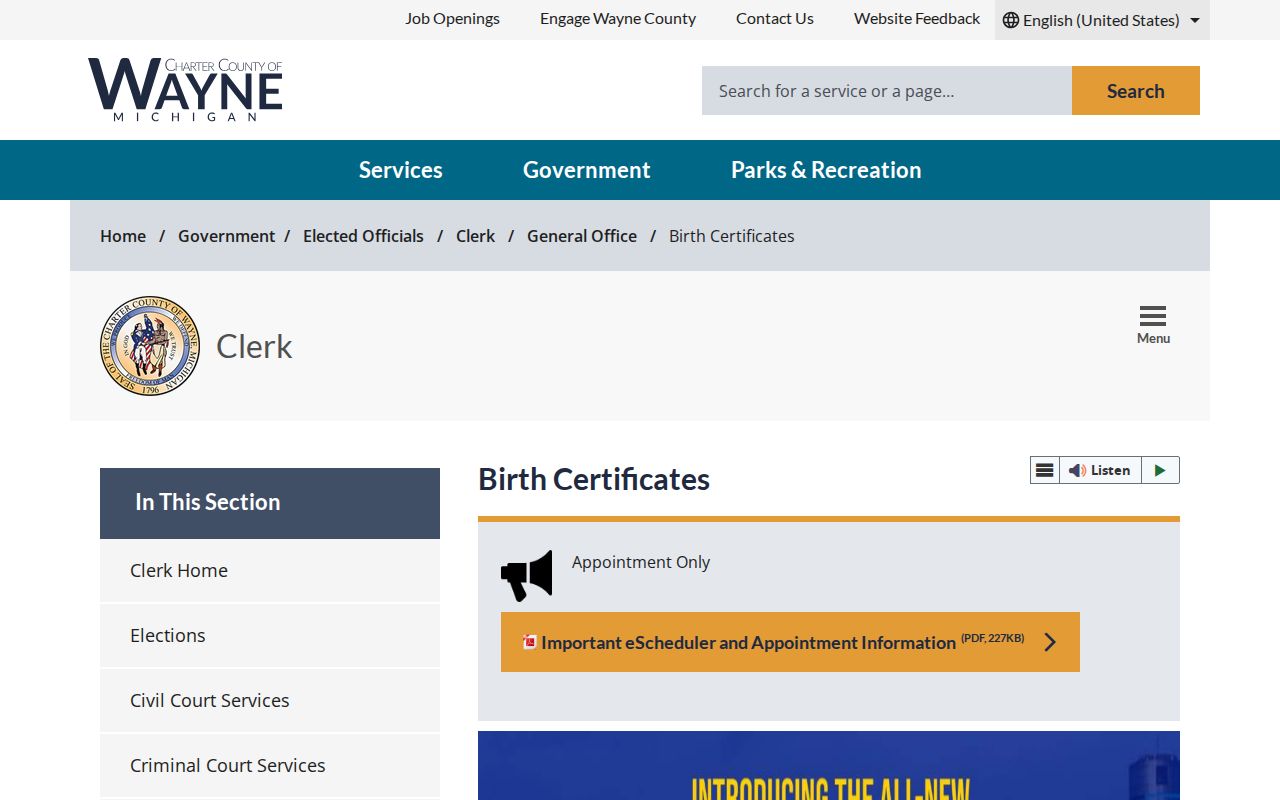
County requirements can support a qualifying event request, but do not produce a list of current Brownstown Township residents.
Verify a Brownstown Township Name Match
Verification tests one identity with more than one record. Start with the record closest to the question, then use a second source that independently supports a date, relationship, parcel, or jurisdiction. A court result and a deed result sharing a name can still belong to different people. Preserve the custodian's limits with every result.
- Write the full name exactly as known, then note a former name, middle initial, approximate year, address, parcel, or court jurisdiction.
- For an ownership question, compare Wayne Treasurer or Brownstown BS&A parcel information with the Register of Deeds grantor or grantee index and legal description.
- For a court question, check MiCOURT D33 when district jurisdiction fits, then use Wayne Circuit or Probate only when their case types fit.
- Request a vital copy only when the event is relevant and the requester meets the custodian's rules. Keep the event fact separate from a later residence claim.
- Resolve conflicts with the responsible custodian. A no-result can reflect spelling, a former name, an offline image, a sealed category, or the wrong jurisdiction.
- Docket
- A court's running list of case events, filings, hearings, and actions. It may be public even when each underlying document is not.
- Index versus image
- An index points to a record through fields such as name, case number, or date. An image is the scanned record itself and may be unavailable, office-only, or subject to a fee.
- Certified copy
- A copy issued by the custodian with official certification. It differs from a portal result or ordinary photocopy.
Note: A full name plus one postal city is not enough to resolve a same-name Brownstown Township match.
MVIC Is Not a Public Name Search
The Michigan Voter Information Center is for a person checking that person's own registration, polling place, districts, and ballot information. It is not a public tool for searching a Brownstown Township street or an arbitrary name. Registration questions can also go to the county or local clerk.
Michigan's Qualified Voter File is different and its request process is controlled. Public QVF fields may include complete name, residential or mailing address when available, year of birth, registration date, status, voter ID, and voter history. Protected data include driver-license or state-ID numbers, month and day of birth, phone, email, signature, partial Social Security number, and protected-address information.
The MDOS QVF request form requires a scoped jurisdiction, date range, format, purpose, and delivery details. Submit through MDOS-FOIA@Michigan.gov or Bureau of Elections, PO Box 20126, Lansing, MI 48901-0726. Documented output can use encrypted media or arranged FTP, not ordinary email. Preserve status codes and dates rather than translating them into a claim of physical presence.
Brownstown Precinct Counts Need Context
A Wayne County 2024 results file reported 2,410 registered voters for Brownstown Precinct 1. That is a dated, aggregate precinct statistic. It is not Brownstown Township's total population, a resident list, or proof that any named person participated in an election. It shows the difference between public election geography and a person-level voter record.
Michigan voters do not register by party affiliation. Election-result files can provide precinct names, registration totals, turnout, and contest totals, but not political preference. Voter-file availability and redaction rules have been subject to recent litigation and administrative change, so verify current MDOS instructions before using voter-derived data.
MiPLUS in a Brownstown Township Lookup
Michigan LARA MiPLUS provides free searches across regulated credentials, including health professions, engineering, surveying, architecture, accountancy, nursing, psychology, veterinary work, and other licenses. A result can show a licensee, type, issue date, expiration or status, and disciplinary action. Certified verification is listed at $15 per license and requires login.
Use a credential as a distinguishing fact when a name and profession match an official record. Capture the license number, type, status, source date, and discipline link when displayed. A listed address, business connection, registered office, agent, or UCC debtor record does not prove that a person currently lives at a Brownstown Township address.
Michigan FOIA and Existing Records
Michigan FOIA, 1976 PA 442, MCL 15.231 et seq., permits requests for existing non-exempt records. It does not require Brownstown Township, Wayne County, or the state to build a new resident list or answer a research question. A useful request names a department, record series, date range, and precise key such as an address, parcel ID, legal description, permit number, or meeting date.
The normal response period is five business days, with one written ten-business-day extension. Search, review, separation, copying, and mailing charges may apply. Existing Brownstown Township targets can include an address-assignment log, permit index, planning packet, board minutes, or cemetery index, subject to exemptions and redaction. The research did not identify a current township FOIA coordinator or fee schedule, so verify the official contact before making a request.
Brownstown's 1827 Record Trail
Historical name work needs a time frame. Brownstown Township records have a local starting point in 1827, although inspected sources disagree whether designation occurred April 5 or April 12. The first township meeting is dated May 28, 1827. Keep source attribution with that disagreement rather than treating one date as resolved.
Municipal changes matter too. For an older resident, search Brownstown, Monguagon, Gibraltar, Rockwood, Woodhaven, and Flat Rock in the appropriate historical slice. A directory, atlas, cemetery record, newspaper, or probate file may use a name that does not match the modern municipal label. It can locate a person in time, but cannot alone prove current status.
Legal Limits on Brownstown Township Records Search
Michigan's Address Confidentiality Program provides eligible survivors of domestic violence, sexual assault, stalking, human trafficking, or risk of harm a designated substitute address and mail forwarding. Government entities, schools, libraries, and voter records must use that substitute address as required. Never use a parcel map, deed, voter file, or combined records to try to locate an ACP participant's physical address.
The Michigan ACP application portal contains sensitive identity and address fields. It is not a research database. Driver and vehicle records have separate DPPA and Michigan restrictions, and restricted vital records, signatures, IDs, Social Security numbers, minors' records, sealed court matters, and confidential address data are stop signs, not gaps to work around.
The ACP application view shows why substitute-address and application data need special protection.
When a public source uses a substitute address, retain it as a substitute address and do not try to triangulate a physical location.
Lawful use. Use records only for lawful, necessary personal, family-history, title, civic, or archival purposes. Michigan stalking law, MCL 750.411h, covers repeated harassment and unconsented contact; do not use a name or address result to stalk, harass, intimidate, impersonate, or harm anyone.